 English
 日本語
日本語 العربية
 French
 Deutsch
 Español
 Portuguese
 Русский
 Bahasa Indonesia
 中文
中文This article draws on national policies, standards and codes, the current state of the industry and public data to carry out an objective technical discussion. Its aim is to make flexible bracket structures sounder and national assets safer; it is not directed at anyone.
— A plain safety baseline, stated by a craftsman working in the field
In recent years, long-span flexible brackets have been deployed particularly quickly.
Those of us who stay on construction sites and work in the field as structural people understand one thing best: whether a bracket can stand up is not decided by how polished the calculation report is, but by how it is actually laid out on site.
In recent years, hundred-megawatt-scale plants in coastal and strong-wind regions have repeatedly suffered rows of collapsed brackets and damaged modules under typhoons and strong winds. A single accident can cost tens of millions or even hundreds of millions, and most of these events are ultimately attributed to "force majeure".
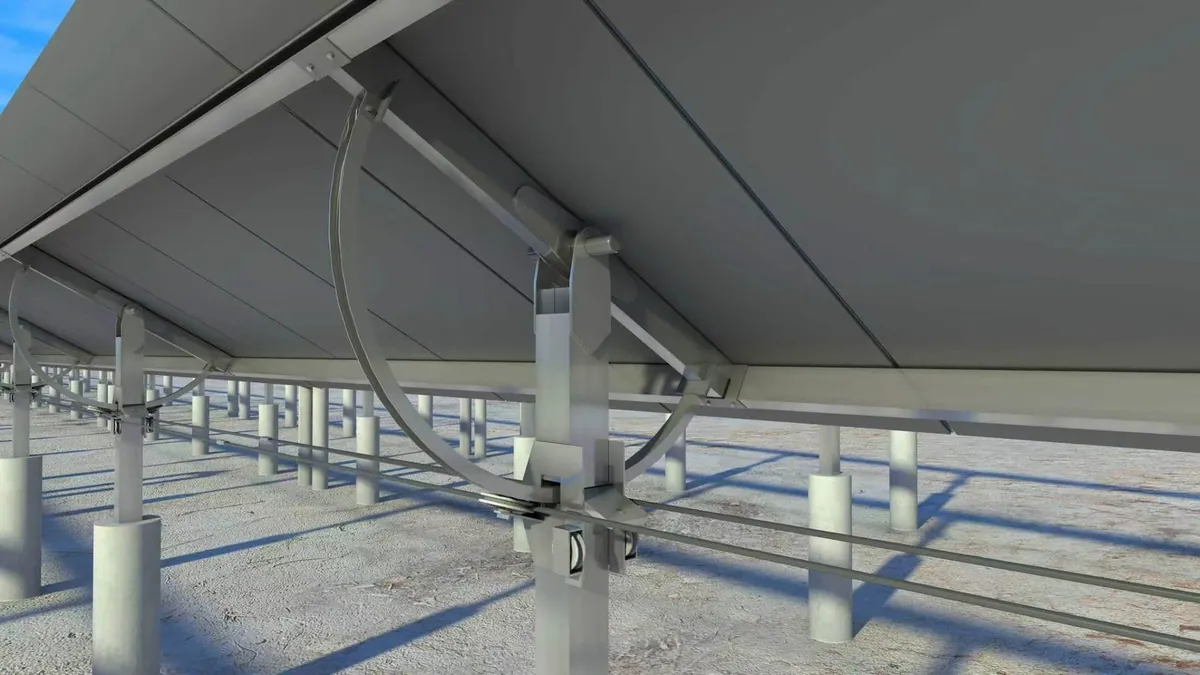
A long-span flexible bracket is suspended along its entire length, without ground piles; it has inherently low damping and is sensitive to wind. Following the same logic as bridge engineering, the larger the span, the denser the supports must be and the fewer members can be left out.
In actual deployment, however, some projects, in order to cut cost and chase longer spans, have widened the spacing of suspended trusses from a sound, safe arrangement to 10, 13 or even 16 metres.
A craftsman who walks onto the site needs no tape measure, no drawings and no calculation report; one glance is enough to know: with this spacing, once a strong wind arrives, the risk is visible to the naked eye.
What is more frustrating is that as long as the calculation report is carefully adjusted and the wind tunnel report is professionally polished — plus stamps, reviews, expert endorsement and university research projects — many seemingly "risky" designs can still pass review and acceptance smoothly.
As a result, the industry has gradually developed a reality that makes people uneasy: the paperwork can be compliant, while the physical structure has quietly been relaxed.
I am only a small craftsman. I do not understand grand policies or grand strategies; I only look at structures, wind conditions and construction on site every day. But one worry I can never put down: with such a large national PV asset base, we cannot end up relying on the weather as the last line of defence, nor let the wind take the blame for everything.
Therefore, I have honestly written down some of the most basic and most intuitive common sense, as a practical suggestion to owners, designers, regulators and standards bodies.
I. In high-wind-pressure regions, hold the plainest red line
In high-wind-pressure regions of 0.75 kN/m² and above, whether it is a 33 m conventional span or a 70 m ultra-long-span flexible bracket, the most basic baseline for laying out suspended trusses comes down to one sentence: the spacing should be kept within 4 metres.
Regardless of brand, project size or span length, this is the most fundamental disaster-prevention common sense for suspended structures in typhoon and strong-wind regions.
Members can be counted and spacing can be measured; no complex mechanics need to be understood and no wind tunnel report needs to be studied. As long as the truss spacing exceeds 4 metres, an experienced craftsman can judge that once the wind really arrives, the structure's wind resistance may already be overdrawn.
II. In low-wind-pressure regions, do not relax either
In regions below 0.75 kN/m², truss spacing should also be laid out scientifically, reasonably and in line with actual conditions, based on the project's wind regime, site conditions and span; it should not be relaxed casually to reduce cost.
The logic of a suspended structure has not changed: the larger the span, the more stable the support points must be; the more active the wind, the fewer members can be spared. A long-span flexible bracket must not sacrifice safety for the sake of span; safety should come first and be controlled strictly.
III. In high-wind-pressure regions, one key safety measure must be added
In regions of 0.75 kN/m² and above, it is also recommended that the project site be provided with a multi-directional stabilizing cable system or an equivalent or better wind-stability device.
The reason is very plain: a suspended flexible structure has inherently weak damping and is sensitive to wind; relying only on the number of trusses as a safety net carries a relatively high risk. In regions with high wind pressure and severe wind damage, a set of structural reinforcement that can genuinely "lock displacement, lock vibration and lock floating" is needed.
This is not a demand on anyone. It is simply a plain statement from an engineer who has worked for decades: where the structure is weak, there must be reinforcement; where the wind is fierce, there must be countermeasures.
IV. Who will safeguard this "visible" safety?
As an engineer, I also understand that lifetime responsibility applies to engineering construction. But in the field of long-span flexible brackets, one reality does exist: complete paperwork does not necessarily mean the on-site structure is compliant.
Therefore, from the perspective of reducing risk, protecting national assets and avoiding post-accident reviews, we sincerely suggest:
1. We suggest that national standards and industry codes add intuitive constructional requirements. In high-wind-pressure regions of 0.75 kN/m² and above, the following could be considered:
• Suspended truss spacing ≤ 4 m
• Provision of a multi-directional stabilizing cable system or a better wind-stability device, written in as normative reference requirements, for the reference of project construction, review and supervision nationwide. This is not one party ordering another; it turns front-line engineering experience into a safe, reliable and referenceable practice.
2. We suggest that owners and tendering parties specify "physical indicators" in technical specifications
In the technical clauses of tendering documents, a category of "indicators measurable on site" could be added:
• Measured truss spacing on site must not exceed 4 m (high-wind-pressure regions)
• The number of support points can be counted span by span
• The configuration of the stability system can be verified on site
The meaning is clear:
Paperwork can be beautified, but the physical work cannot be fudged or cut short.
3. We suggest that "physical construction" be included as an important reference in project traceability
Because lifetime responsibility applies to engineering construction, if large-scale instability or collapse occurs in the future, regulators, owners, auditors and quality supervision departments can carry out an objective review against the physical structure on site, for example:
• Whether the actual truss spacing is within the specified range
• Whether the stability system has actually been installed
• Whether members have been substantially reduced
This is only a plain statement from an engineer: engineering safety ultimately comes back to the physical work on site.
V. Finally, words I cannot hold back
There is an old saying in engineering construction: "A sound structure matters more than anything."
For a long-span flexible bracket, the larger the span and the higher the risk, the less it can rely on calculation models, endorsements and stamps as a safety net.
With such a large national PV asset base, every hundred-megawatt-scale plant represents public investment of hundreds of millions or even billions. All we can do is one thing: state clearly and write down the plainest, most intuitive safety common sense that can withstand wind and rain. We do not ask for adoption or recognition; we only hope for fewer losses in the future, less national asset wasted for nothing, and fewer stories of "letting the wind take the blame".