
An ultra-long array tracking system that carries PV modules on prestressed steel cables, purpose-built for large-scale PV plants on flat sites such as level deserts and open water surfaces, delivering a one-stop solution from selection and supply to acceptance support for PV plant investors and EPC contractors.
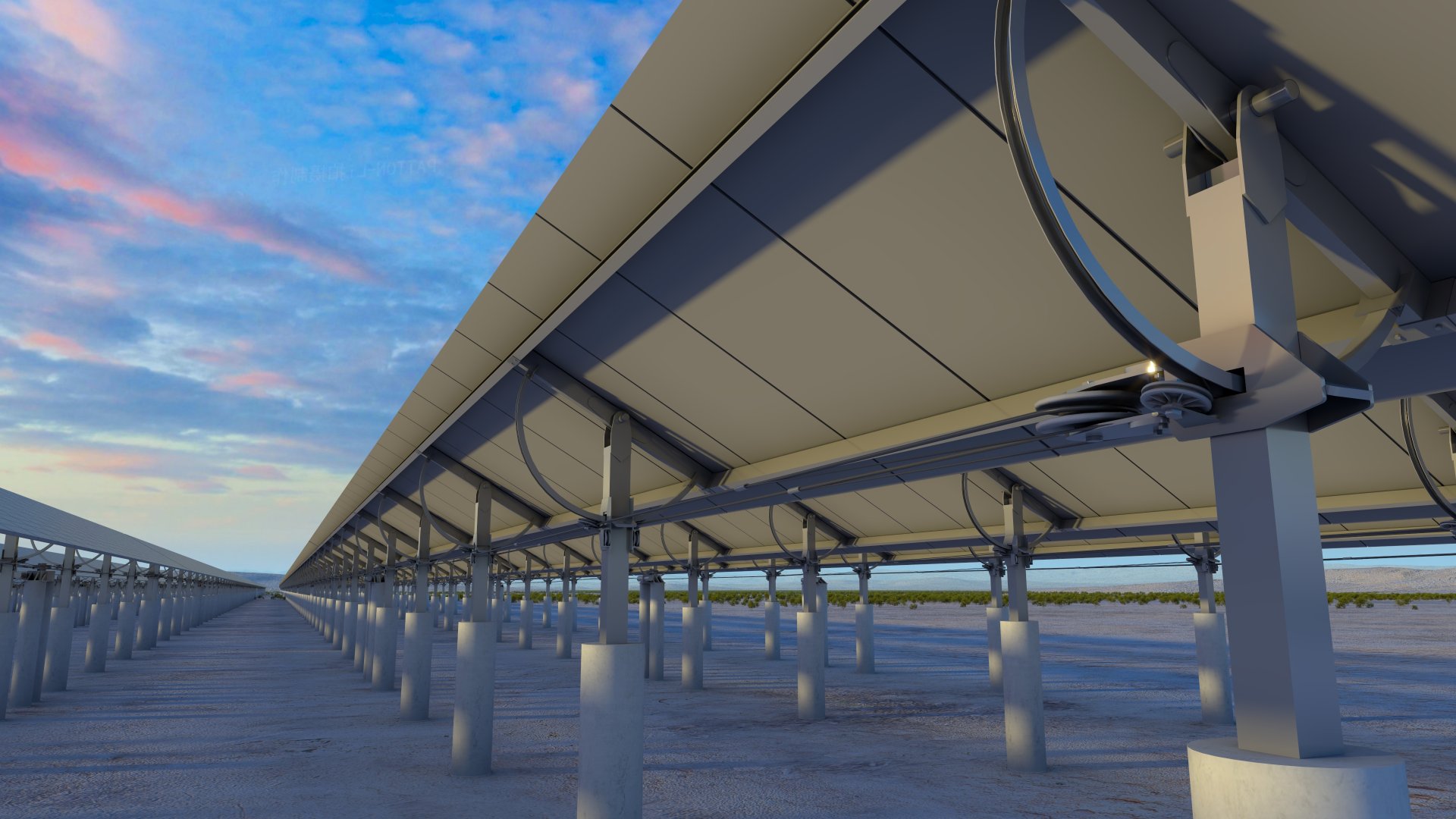
| Product name | Cable-Supported Ultra-Long PV Tracker |
|---|---|
| Tracking mode | Single-axis tracking (cable-supported structure) |
| Continuous array length | 300 m to 1000 m |
| Modules per array | More than 520 |
| Drive configuration | One motor (≤180W) + one slew drive + one tracking controller for the entire line |
| Dampers | None; rigidity comes from independent locking on each vertical post |
| Bearings and lubrication | Fully bearing-free, lubrication-free hinged structure |
| Wind protection | AI predictive wind protection, activated at wind speeds of 30 m/s and above |
| Steel consumption | Approximately 40% less than conventional trackers at the same installed capacity |
| Stacking volume of split parts | Reduced by about 30%, cutting container and ocean freight volume |
| Structural validation | Accelerated marathon fatigue testing of the complete tracker, verifying performance equivalent to a full 25-year service life; owners, supervisors and EPC teams may witness on site |
| Slew drive replacement | The slew drive for 1MW can be replaced by two skilled workers within one hour, with no on-site calibration |
| Warranty | 20-year automotive-grade overall warranty (slew drive 20 years, tracking controller 15 years) |
| Manufacturing and delivery | Annual delivery capacity above 30GW, supporting batch supply and scheduled delivery |
| Suitable sites | Flat sites such as level deserts, open water surfaces, tidal flats, wastewater treatment plants and coal mining subsidence areas |
The cable-supported ultra-long PV tracker achieves breakthroughs across all performance dimensions through mechanical innovation, bearing-free and lubrication-free technology, a lightweight minimalist drive, AI wind protection and an owner-participated open pre-verification system. It provides a new-generation tracking solution for global flat-site PV projects that combines low investment, low carbon emissions, high energy yield, long service life and low maintenance.
Compared with conventional tracking brackets, the difference lies not in replacing a single part but in rebuilding the load-bearing system: PV modules are carried directly on prestressed steel cables that run continuously along the array, while vertical posts support the array independently at each span and lock each rotating joint independently, forming a flexible tracking line that can extend continuously for hundreds of meters.
Conventional single-axis PV trackers deployed worldwide suffer from inherent reverse-lever loading mechanism defects and eccentric dead load defects that cannot be fully eliminated. These are the root causes of equipment vibration, progressive wear and even collapse.
In traditional designs, the slew drive serves as a short effort arm, while the torque tube and the PV array form an extremely long load arm. Under strong wind the force reverses: the array becomes a long effort arm prying the slew drive, creating persistent oscillation and accumulated gear backlash. In addition, modules are mounted outside the torque tube, so a 30°–45° tracking angle generates a large eccentric secondary bending moment, which strong wind further amplifies, accelerating structural fatigue.
The cable-supported structure changes the relationship of the lever arms: steel cables carry the modules and transmit force continuously along the array, while vertical posts support and lock the array at multiple points within each span. The load path no longer depends on a single slew drive resisting reverse-lever loading, and eccentric loads are distributed across the continuous cable system and the post system, weakening the causes of vibration and fatigue at the mechanical source.
The complete array adopts an industry-leading minimalist drive configuration: one ultra-low-power motor of no more than 180W, one slew drive and one tracking controller for the entire line. This removes more than 90% of electrical failure points at the source and greatly lowers the system failure rate.
Fewer drive units reduce not only procurement cost but also failure point density, cable consumption and maintenance workload. Conventional trackers use many drive units with densely distributed failure points, and any abnormal drive link affects the array section it controls. The minimalist drive compresses the possible failure points into the smallest possible set, making the availability of the whole array more controllable.
The product achieves a breakthrough with a fully bearing-free, lubrication-free hinged structure: all rotating and joint positions discard conventional sliding or rolling bearings and require no grease maintenance. Free from bearing corrosion, jamming, abrasion and abnormal noise, the system is naturally tailored to the 25-year outdoor service life of a PV plant and withstands repeated accelerated fatigue cycles, drastically cutting lifetime maintenance work and mechanical loss.
Built with independent locking on each vertical post, the system establishes overall rigidity and stability and completely removes the dampers that conventional trackers require, eliminating the long-term safety hazards caused by damper aging, leakage and failure.
Maintenance is simplified as well: the tracker adopts a split plug-in modular structure without on-site calibration, and the slew drive corresponding to 1MW can be replaced completely by two skilled workers within one hour, with immediate re-commissioning after replacement.
The system is equipped with AI predictive wind protection, redefining the passive wind safety logic widely used in the industry: the algorithm predicts extreme wind conditions and only triggers protective stowage at wind speeds of 30 m/s and above. Under ordinary strong winds, modules do not need to be stowed flat, maximizing effective generation hours throughout the year and continuously improving plant output and returns over the full lifecycle.
It is worth noting that in this product AI wind protection plays a redundant protection role rather than the life-saving measure it becomes in conventional designs, where stowing the modules flat is the only way to hold structural risk in check — the structure itself already gains higher wind redundancy by removing dampers and eliminating reverse-lever loading.
Following the validation standards used to type-approve mature mechanical and electrical products such as automobiles, agricultural machinery and home appliances, we have established an industry-exclusive accelerated marathon fatigue testing system for the complete tracker, filling the global gap in pre-delivery full-tracker validation for PV trackers.
Unlike the practice of internal testing and paper certificates, owners, supervisors and EPC teams may witness the testing on site before mass production. Structural fatigue, cyclic loads and extreme-condition performance equivalent to a full 25-year service life are verified, so that all structural risks are intercepted before delivery and public witness testing replaces vendor self-certification.
On product durability, the company has also built a world-exclusive century-equivalent weathering test system that verifies long-term durability through severe accelerated aging, and collaborates with universities and institutes on structural safety validation.
Backed by the world-class PV steel industrial cluster in Tianjin, the company achieves an annual delivery capacity above 30GW and has the strength to deliver large-scale global clean energy plants, supporting batch supply and scheduled delivery for large centralized PV projects.
Our services cover one-stop technical support including design consultation, installation guidance and acceptance assistance. The company also holds multiple advanced PV mounting patents and offers patent transfer and licensing.
Please provide your project capacity, site location, ground or water surface type and planned schedule. We will reply with a solution and quotation within one business day.
Copyright © 2026 Tianjin Aqini New Energy Technology Co., Ltd.. All rights reserved Sitemap
 English
 日本語
日本語 العربية
 French
 Deutsch
 Español
 Portuguese
 Русский
 Bahasa Indonesia
 中文
中文