 English
 日本語
日本語 العربية
 French
 Deutsch
 Español
 Portuguese
 Русский
 Bahasa Indonesia
 中文
中文In the PV flexible bracket system, the anchor is the core component that determines the structural safety of the plant, carrying the full-dimensional technical requirements of precise mechanical matching, structural fatigue resistance, dynamic adaptation of prestress and long-term anti-corrosion protection. Anchor technology is mature in the fields of bridges and large buildings, with a complete theoretical system and rigorous design logic.
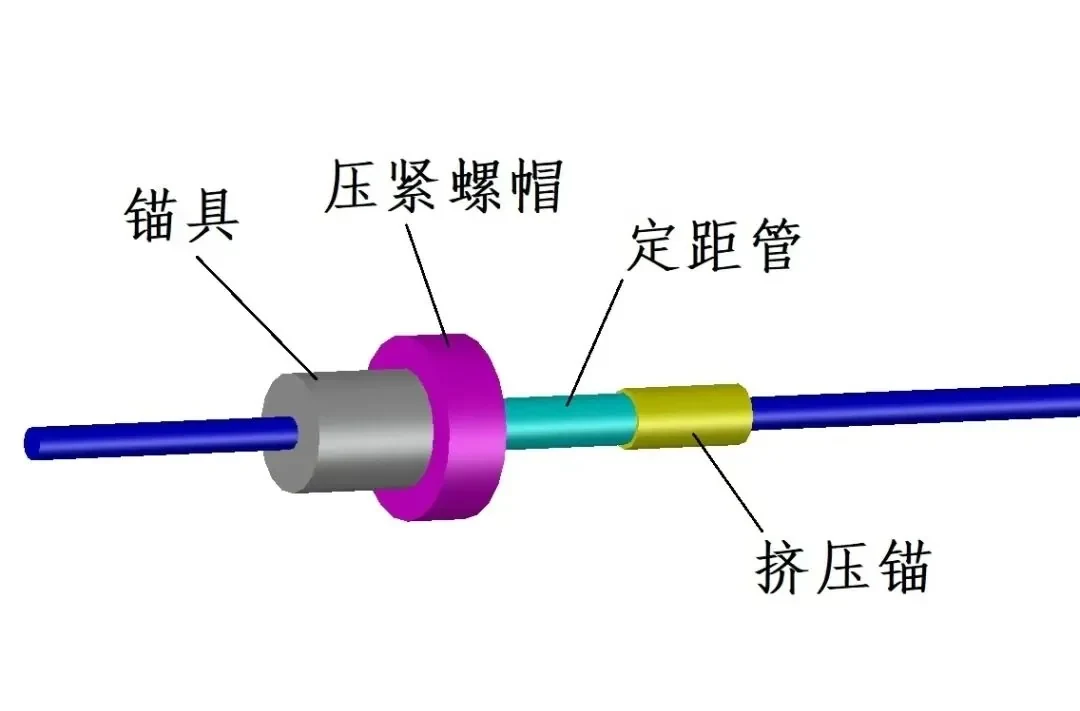
For the long-term safety and whole-cycle durability of PV flexible brackets, the industry has for many years continuously brought together top universities and academician teams, and invested massive research resources, testing costs and R&D effort, always striving to develop a dedicated anchoring system that truly fits PV scenarios. But judging from the reality of today's market, after many years of continuous effort, the domestic PV flexible bracket field still generally uses a three-part assembly of bridge wedge anchors combined with spacer tubes and tail extrusion anchors.
This habitual non-standard patchwork scheme of the industry remains the market mainstream after many years of iteration, and the fundamental problem of safe operation over the 25-year whole life cycle of PV flexible brackets has still not been thoroughly solved despite years of massive investment.
I. The redundant spacer tube: a compromise the industry still cannot replace after years of effort
From the underlying logic of structural mechanics, the spacer tube is a purely auxiliary fitting: it takes no part in the main load bearing, does not raise the anchor's load capacity, does not improve overall durability, and is added passively only to accommodate the assembly of the tail extrusion anchor.
Despite years of technical iteration, repeated structural improvements and continuous research, the industry has never escaped the patch-style improvement mindset for flexible bracket anchors, and still has to rely on adding an ineffective spacer-tube member to compensate for the slip defect of traditional bridge anchors under the low-tension conditions of PV — a remedial structure still in use after years of effort.
Precisely because this structure must rely on the superposition of three sets of components — wedge anchors, spacer tubes and extrusion anchors — procurement costs pile up; at the same time, site construction requires special extrusion equipment, high-altitude scaffolding and a full set of lifting tooling.
During the installation of PV flexible brackets, the construction crew must repeatedly move equipment, erect and dismantle high-altitude work platforms many times, and perform high-altitude extrusion point by point. The industry's standard extrusion cost per point has long stayed in the range of 40–80 yuan. The cumbersome procedures not only greatly raise the construction and installation cost of PV flexible bracket projects, but also directly lengthen the overall construction period; labour loss, equipment loss and high-altitude work loss remain high, burdening all flexible bracket projects year after year with unnecessary cost and schedule pressure.
According to the general structural design principles of the state and the industry: a quality anchoring system must achieve a straight force path, coaxial load bearing and simple nodes, minimize redundant transfer members, and avoid the stress concentration hazards brought by multi-level superposition.
We sincerely respect the industry's persistent R&D investment over many years, with research institutions and flexible bracket manufacturers working deep in the field and making repeated breakthroughs. But the objective reality is that after long-term effort, the core barrier of underlying structural adaptation still exists, and the industry can only rely long-term on stacked fittings and patch repairs to make up for safety shortcomings — an objective situation that remains unchanged after years of exploration in the domestic PV flexible bracket industry.
II. A misalignment of understanding: massive research investment that still has not escaped the logic of applying general products
The "double protection" structure widely promoted in today's PV flexible bracket industry is the mainstream structural scheme polished through years of R&D and iteration, embodying the effort and investment of many research teams, experts, scholars and flexible bracket companies.
We have always respected all the industry's research achievements and technical explorations.
But based on many years of front-line engineering deployment, comparison across all working conditions and long-term O&M observation, a very clear industry reality lies before us: leading domestic flexible bracket manufacturers, with top research forces and years of heavy investment, have still not developed an anchoring system truly suited to the dedicated working conditions of PV flexible brackets.
The high-stress static conditions of bridges and the low-tension, high-frequency vibration, long-life conditions of PV are two completely different mechanical systems and design logics.
Directly transplanting mature bridge anchoring structures to PV flexible bracket scenarios produces a large number of hidden adaptation defects. After years of continuous investment in improvement and iteration, the industry still can only deploy patchwork, remedial structures as the mainstream scheme on a large scale.
The current general design baseline for prestressed structures, cable structures and PV flexible bracket support structures is very clear:
Anchoring nodes must possess whole-life-cycle capabilities of adjustability, maintainability, re-tensioning and replaceability; the main load-bearing structure should not adopt one-time locked construction; node design must transfer force simply and reduce redundant transfer members, to guarantee 25 years of stable operation of the PV plant.
It is not that the industry's research bodies and technical teams are unfamiliar with general design principles; it is that after years of massive effort they still cannot achieve the technical implementation of a PV-dedicated anchoring structure, and can only rely on the general bridge anchor system, passively making up shortcomings by stacking fittings and adding protective structures.
Evaluated objectively from an engineering practice perspective: such patchwork structures carry relatively controllable risk in low-wind-pressure, small-span mountain flexible bracket projects, where the stability of the main cable structure can be assisted by adjusting the tension of ground wind-resistant cables.
But in long-span PV flexible brackets, high-wind-pressure regions and the harsh corrosive conditions of the southeast coast, the long-term safety risks brought by structural fatigue hazards, O&M blind spots and locked-construction defects always exist objectively and cannot be avoided.
Within the 25-year operating cycle of a PV plant, stress relaxation of the strands, deformation from temperature differences and continuous wind vibration keep the cable tension in a constantly changing state. The permanent locking characteristic of the industry's general extrusion anchors has not been broken through despite years of technical iteration; flexible bracket companies have invested great R&D effort, and to this day there is no feasible, maintainable alternative structure.
III. The essence of "double protection": years of repeated improvement that still have not broken the inherent structural limits
The industry's mainstream double-structure superposition protection model is the highest safety configuration that the domestic flexible bracket industry can implement after years of continuous R&D and repeated optimization, embodying the R&D investment and technical accumulation of the whole industry.
But from the essence of mechanical adaptation, the industry's two superimposed remedial structures correspond precisely to the two inherent technical bottlenecks that years of effort have never broken through.
First, the working-condition adaptation bottleneck:
Traditional bridge anchors self-lock on the basis of an ultimate tension stress above 70%, whereas PV flexible brackets operate long-term in a low-stress range of 20%–30%.
In this low-stress range, the grip is insufficient, the wedge teeth fit unstably, and micro-slip arises easily — a structural defect common to all general anchors with fixed die parameters.
Despite years of improvement and optimization, the industry has never broken the fixed limits of the general die, and can only reinforce the risk by adding external structures.
Second, the O&M structure bottleneck:
The addition of the tail extrusion anchor is a passive reinforcement the industry developed to compensate for the slip defect of the main anchor. But once assembled, the extrusion anchor is permanently locked: it cannot be re-tensioned, cannot compensate tension, and cannot be maintained non-destructively. After years of iteration and optimization, the industry still has no implementable, replaceable, maintainable mature scheme.
Once tension decay or anchor displacement appears in long-term operation, the site can only violently cut out the extrusion anchor. The unbalanced load release at a single point can easily trigger chain load imbalance across a whole span of large-span flexible brackets, creating collapse risk — a core engineering pain point that years of effort have still not thoroughly solved.
We sincerely recognize the industry's decades of dedication and effort, with research forces continuously invested and repeatedly refined. It is only that the inherent working-condition barriers objectively exist: after years of iteration, the PV flexible bracket industry still has to use remedial, patchwork traditional structures.
IV. The industry's biggest technical blind spot: years of mass production without ever building a load-customization system
All anchors currently supplied for flexible brackets in China adopt a general mass-production model of fixed dies, fixed tapers, fixed tooth profiles and fixed parameters.
This standardized mass-production system is mature and stable, delivers efficiently and has low mass-production cost, and fits high-load, standardized conditions such as bridges and buildings well.
But every PV flexible bracket project is a differentiated working condition: different spans, different wind pressures, different loads, different cable tensions, different vibration frequencies and different corrosive environments — the mechanical parameters of every project are unique.
In terms of the rigour of structural design:
Different main cable loads and different design tension ranges must be matched with dedicated wedge tapers, dedicated tooth profile parameters, dedicated grip lengths and dedicated pretension locking structures.
As the core load-bearing component of the PV flexible bracket, the anchor must be precisely customized one-to-one strictly according to the project's structural calculation report, the set value of the main cable load and the design tension range. It must never be applied across all of the country's complex working conditions with a single general die and fixed parameters.
The domestic industry possesses mature die R&D, machining and mass-production capabilities, and flexible bracket manufacturers keep investing in R&D iteration; yet after years of mass-production development they have remained at the level of general application, and to this day have not built a one-to-one dedicated customization R&D system based on load calculation reports.
We have worked deep in the field for many years and taken part in a large number of project deployments and O&M reviews, and we fully understand the current situation:
General mass production means fast delivery, a mature supply chain and controllable cost;
Load-customized R&D is difficult, requires many test rounds, has long verification cycles and an extremely high technical threshold.
For years the industry has done its best to optimize safety schemes within the framework of "mass-producible and deliverable", with massive R&D continuously stacked on, yet it has never escaped the inherent path of general mass production.
V. A cross-domain technical barrier: flexible bracket companies keep striving, but the two families of working conditions never merge
That PV flexible bracket anchoring technology has been hard to break through for years is by no means due to insufficient industry investment.
The core crux is that the bridge high-load static prestress system and the PV low-tension dynamic flexible cable system have a natural cross-domain technical gap.
Traditional anchor companies are deeply versed in high-load, static anchoring technology; PV flexible bracket companies are good at light steel structure layout and generally lack the underlying technical accumulation in precise dynamic prestress, long-life fatigue and micro-tension self-locking.
The two systems differ completely in load models, fatigue standards, durability logic and operating environment. Even with the industry's top research forces and years of heavy investment, only surface repair and optimization has been possible — a dimensional breakthrough in underlying working-condition adaptation has not been achieved.
We sincerely admire the decades of dedication, persistence and research investment of research teams, industry experts and flexible bracket companies. It is only that the cross-domain technical barrier genuinely exists, and after years of exploration the industry has still not achieved a fundamental technical leap.
VI. The way out: from general mass production to a PV load-customized dedicated system
Based on the industry's long-standing reality and objective technical barriers, we have worked in PV flexible bracket anchoring for many years, stepped outside the general design mindset of traditional bridge anchors, and completed a reconstruction of the underlying structure based entirely on the dedicated working conditions of PV — low tension, high-frequency vibration, long-life maintenance and multi-scenario corrosion.
The low-tension anchor system completely abandons the industry's years-long patch-style, superposition-style and remedial improvement route, and is strictly customized one-to-one according to the project's load calculation report, truly achieving precise matching of working conditions:
According to the project's main cable load value, design tension and span conditions, the wedge taper, tooth profile and grip length are custom-matched, thoroughly solving the industry-wide problem of slip at low PV stress;
All ineffective transition members are removed, achieving a straight force path and integrated load bearing, and completely eliminating the hazard of multi-level stress concentration;
The one-time locking structure of long-span flexible bracket anchors is completely abandoned, and a whole-cycle, non-destructive re-tensioning, adjustable and maintainable O&M channel is preserved throughout the 25-year life;
An innovative external independent circulation locking structure provides ample pretension and stable gripping, perfectly fitting high-frequency vibration fatigue conditions;
A fully enclosed sealed anti-corrosion system is adopted, fitting all scenarios such as mountains, water areas and highly corrosive coastal environments;
It follows the industry's general structural design baseline throughout, saying goodbye once and for all to general application and non-standard patchwork, and achieving condition-specific compliance for PV flexible brackets.
The PV flexible bracket anchor is the core foundation of plant safety.
General mass production fits standardized, high-load industrial scenarios;
Load customization, condition matching and dedicated design are the only way out for the complex working conditions of long-span flexible brackets.
Products will eventually iterate. We firmly believe that with the joint efforts and support of the entire PV flexible bracket industry, PV flexible bracket anchoring technology will surely move from "general make-do" into a new era of refinement and professionalism — "condition customization, load matching and dedicated design".