
 English
 日本語
日本語 العربية
 French
 Deutsch
 Español
 Portuguese
 Русский
 Bahasa Indonesia
 中文
中文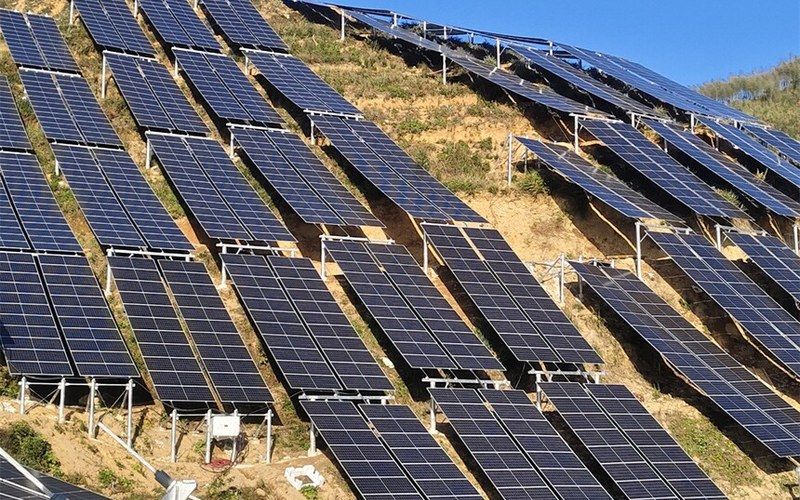
Why Edge Structures Decide Flexible Bracket Safety
Thanks to their unique structural advantages, flexible PV brackets account for a growing share of PV power plants. However, even after nearly ten years of development, the technology is still at an early stage, and collapse accidents caused by technical immaturity have been frequent. Looking at the many collapse cases, the main cause is defects in the design of the edge structure. The edge structure of a flexible bracket consists of edge piles, anchors, diagonal anchor cables and anchor pile foundations. The rationality of the edge structure design is crucial to the safety and stability of the whole bracket.
The Anchor Pile: The Bridge Anchorage of a Flexible Bracket
In a flexible bracket, the anchor pile is as critical as the anchorage of a suspension bridge — it is the part that controls the safety and stability of the entire structure. Analysis of collapse cases shows that most collapses happen because the anchor pile failed: unable to bear the load of the array's flexible bracket, it was pulled out of the ground, and the bracket collapsed. Part of the reason is the desire to reduce plant investment cost; part is the designer's insufficient understanding of the overall flexible bracket structure.
Notably, some designers habitually build a full structural model based on the data supplied by the client and calculate the whole structure as one, but rarely split the flexible bracket into components and calculate them separately. This neglected approach not only affects safety but also increases cost and creates unnecessary secondary expenditure. To ensure safety and stability, the more reasonable method is to calculate the anchor pile foundation as a separate item, with medium-to-high safety coefficients. The middle structure of the flexible bracket, when safety is assured, may adopt a more economical design. For flexible brackets in mountain and hill PV plants, special attention is needed: calculate the downslope force of each array according to the slope angle of the hillside where each array sits and the number of arrays, and add that value to the anchor pile foundation load of the upper slope to obtain the total load value of the anchor pile foundation. This effectively avoids the error between the anchor pile foundation and the actual load caused by construction and geological factors, and reduces the risk of bracket collapse.
A Cost-Effective Anchor Pile Foundation Solution
Common flexible bracket anchor pile foundations include PHC pipe piles, cast-in-place concrete piles and concrete caps. There is also a lower-cost pre-embedded anchor block pile foundation, which can be made in two ways: precasting the block and burying it, or excavating, casting in place and then burying it. Both methods use relatively little concrete — the total cost is about 50% of a traditional PV pile foundation. Where geological conditions allow, this anchor pile foundation can save substantial cost for PV flexible bracket plants.
The construction procedure is as follows:
- Excavate according to the drawings. For the precast method, place the pre-cast concrete block into the excavated pit; for cast-in-place, work to the design drawings.
- Connect the anchor block to the edge pile using galvanized unbonded strand. Each two diagonal anchor cables correspond to one main strand of the flexible bracket.
- After anti-corrosion treatment of the anchor at the end of the diagonal cable strand, connect one end to the edge pile and the other end to the pre-embedded reinforcement loop of the anchor block.
- Dig a cable trench at the diagonal cable position with a width of 30 cm and a 45° inclination, so that the anchor cable can be connected between the anchor block and the edge pile at a 45° angle.
- Apply 5 kN of prestress to the anchor cables, then backfill and compact the earth and rock.
- Apply 10 kN prestress to the main strand of the PV modules, then apply 10 kN to the diagonal anchor cable prestressed strand.
- The main strand of the flexible bracket can then be prestressed to its design value, completing the construction.
Key Takeaways
- Calculate the anchor pile foundation as a separate item with medium-to-high coefficients — never rely on whole-model calculation alone.
- On slopes, add the array downslope force to the upper anchor pile foundation load.
- The pre-embedded anchor block foundation saves about 50% of foundation cost where geology permits.